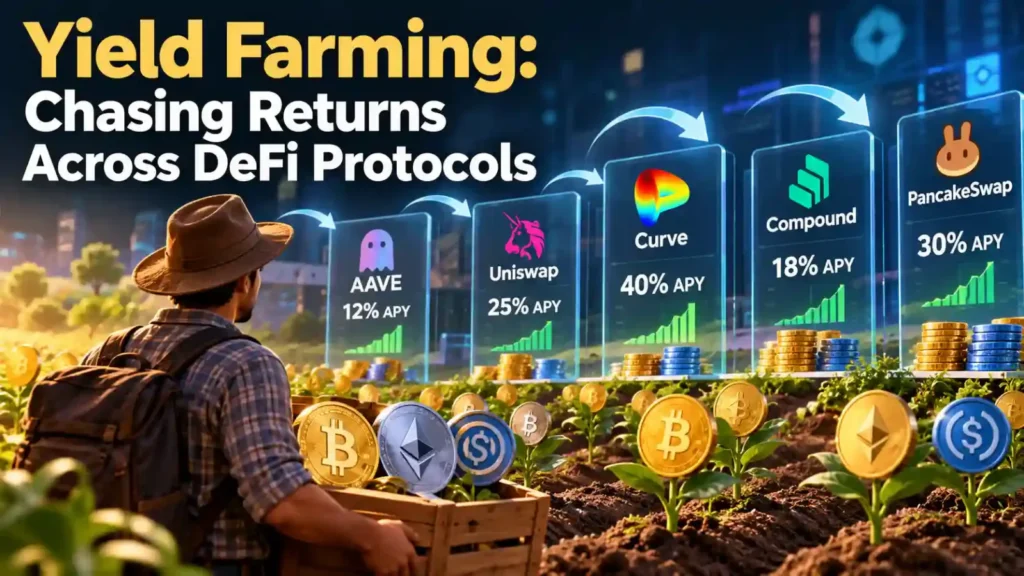
Yield Farming: Chasing Returns Across DeFi Protocols
Staking usually means locking crypto with a single network and earning rewards the protocol pays for securing it. Yield farming is a more active and riskier game hence moving funds between decentralized finance (DeFi) protocols to chase the best advertised return. The headline numbers can look spectacular. What you actually keep is a different matter.
What Yield Farming Actually Involves
Yield farming means putting your crypto to work in DeFi protocols, usually in one of two ways: supplying liquidity to a trading pool, or lending assets on a lending platform. In return you can earn three kinds of reward:
-
Trading fees, paid to liquidity providers when people swap tokens in the pool (this is how Uniswap-style pools pay).
-
Interest, paid by borrowers on lending platforms such as Aave.
-
Incentive tokens, extra tokens a protocol hands out to attract liquidity.
Rates change constantly, so farmers often shift funds from one protocol to another, sometimes using automated tools to do it. That is the main difference from protocol-level staking (for example, Ethereum validators), where funds stay in place and the network pays the reward.
It is tempting to say farming earns more than staking. It is more accurate to say it advertises higher yields. After impermanent loss, falling reward-token prices, gas fees and tax, the net result can be lower than a plain staking return, or negative. Staking is not risk-free either: slashing penalties and counterparty or smart contract risk (in pooled and exchange staking) apply there too.
The Real Risks Behind Attractive Yield Numbers
Say a pool advertises a 40% annual return. That is far above typical staking rates, and a number like that usually has a reason behind it.
-
Smart contract risk. DeFi runs on code. A bug or exploit can drain a pool, and newer, less battle-tested protocols carry more of this risk. Most protocols are not insured against it.
-
Reward-token risk. If your yield is paid in a newly launched token, its price can fall faster than you earn it.
-
Impermanent loss. When you provide two assets to a pool, the pool automatically rebalances as prices move. If the relative price of the two assets changes, you can end up with less value than if you had simply held them. The loss depends on how far the price ratio moves, not which direction it moves, and it shrinks if prices return to where they started. Uniswap’s documentation gives roughly 5.7% for a 2x price change and about 25.5% for a 5x change. Trading fees can offset some of it, and pools of two stablecoins are far less exposed.
-
Liquidity and other risks. On lending platforms you can only withdraw what is not currently lent out. Stablecoins can lose their peg, borrowed positions can be liquidated, and some projects are outright rug pulls or depend on a few admin keys.
A worked example. Suppose you deposit ₹4 lakh and earn a genuine 40% a year, paid in a reward token. That is ₹1.6 lakh worth of tokens at the price when you earn them. If the token loses half its value before you sell, those rewards are worth only ₹80,000, an effective 20% return. Add impermanent loss on the deposit itself, gas fees and tax, and the net result can be well below what the dashboard promised, or a loss.
Why Sustainability of a Yield Matters More Than Its Size
Experienced DeFi users are skeptical of very high advertised yields, and with good reason. Such yields are often a temporary promotion to attract early liquidity, or a sign of risk that the headline figure hides.
The useful question is where the yield comes from:
-
Trading fees reflect real activity in the pool, and last as long as people keep trading there.
-
Borrower interest reflects real demand for loans, and moves with how heavily the platform is used.
-
Newly issued tokens are the weakest source. If a yield is mostly emissions with nothing real behind it, it tends to fade, and the token’s price often fades with it.
A modest yield from real fees or interest is usually worth more than a huge yield paid in printed tokens.
What Indian Readers Should Know About Tax
Crypto is not banned in India, but it is taxed heavily and there is still no dedicated crypto law. As generally understood:
-
Income from transferring a virtual digital asset (VDA) is taxed at a flat 30% (plus surcharge and cess) under Section 115BBH. Only the cost of acquisition can be deducted, and losses cannot be set off against other income.
-
A 1% TDS applies under Section 194S on VDA transfers above certain thresholds. Whether and how it applies to DeFi activity with no identifiable payer is unsettled.
-
Tax advisers commonly treat farming and staking rewards as income when you receive them, at their rupee market value, taxed at your slab rate. That value then becomes your cost of acquisition, and a later sale is taxed again at 30% on any gain. Because the Income Tax Department has not spelled this out, treat it as a common professional interpretation rather than settled law.
Rules and numbering may change (the Income-tax Act, 2025 has renumbered sections from 1 April 2026), so check current rules or speak to a chartered accountant before acting.
FAQ
Is yield farming riskier than simple staking? Generally yes. It typically adds smart contract risk across several protocols, exposure to volatile reward tokens and, for two-asset pools, impermanent loss. Staking has its own risks, such as slashing, but fewer layers of them.
What is impermanent loss? It is the reduction in value you can suffer when you provide two assets to a pool and their relative price changes, compared with simply holding them. It is “impermanent” because it can shrink or disappear if prices return, but it becomes permanent when you withdraw at a moved price.
Are very high yields usually sustainable? Often not. They frequently come from temporary incentives, high underlying risk or token emissions that cannot last.
Are farming rewards taxable in India? Generally yes, and selling the tokens later is taxed separately at 30% on the gain. See the tax section above, and confirm with a professional.
Bottom Line
Yield farming can pay well, but the advertised percentage tells you little about what you will actually keep. Impermanent loss, falling reward-token prices, smart contract failures and tax all come out of that number. Before chasing a yield, find out where it comes from, how it is paid and what could go wrong. This article is general information, not investment or tax advice, and the regulatory and tax position described is as of October 2026.
Sources
-
Uniswap v2 docs, Understanding Returns: https://docs.uniswap.org/contracts/v2/concepts/advanced-topics/understanding-returns
-
Uniswap docs, Concentrated Liquidity: https://docs.uniswap.org/concepts/protocol/concentrated-liquidity
-
Aave v3 docs, Overview: https://aave.com/docs/aave-v3/overview
-
Ethereum.org, Staking: https://ethereum.org/en/staking/
-
Ethereum.org, Decentralized finance (DeFi): https://ethereum.org/en/defi/
-
Income Tax Department, Taxation of Virtual Digital Assets: https://incometaxindia.gov.in/w/taxation-of-virtual-digital-asset-vda-
-
Income Tax Department, VDA taxation PDF (Jan 2026): https://www.incometaxindia.gov.in/documents/20117/42998/Taxation-of-Virtual-Digital-Asset-VDA_2026-01-06_06-43-57_cfe04a_en.pdf/153706c8-7b5c-77d4-fc56-624c50ece1b0
-
KoinX, Tax on crypto passive income (professional interpretation, not official): https://www.koinx.com/in/tax-guides/tax-on-crypto-passive-income
—
Related: What Is Capital Gains Tax? What You Actually Owe When You Sell an Investment
Related: What Is TDS? Why Tax Gets Deducted Before Money Even Reaches You