
PERSONAL FINANCE
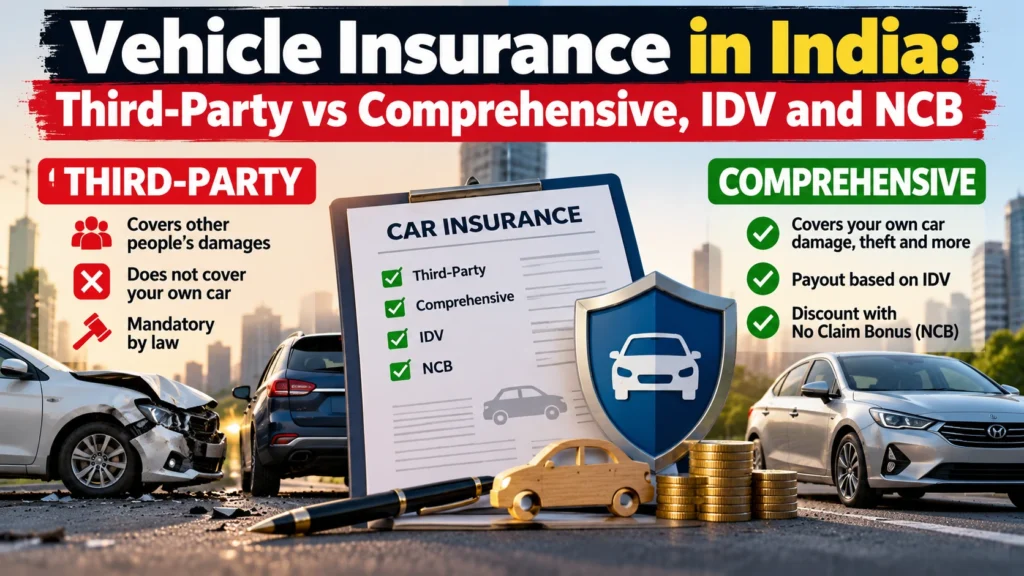
The law forces you to buy only one kind of motor insurance, and it is the kind that does nothing for your own car. Third-party cover protects other people from you. If you want the policy to pay when your car is dented, flooded or stolen, you need comprehensive cover, and the price and payout of that policy come down to a few numbers worth understanding before you click renew.
A valid third-party policy is compulsory for every vehicle on a public road under the Motor Vehicles Act. Driving without one is an offence under Section 196: up to three months in jail or a fine of ₹2,000, or both, and ₹4,000 for a repeat offence. That is the small cost. The large cost is an accident without cover, where a tribunal can order you to pay a victim’s claim from your own pocket.
The third-party premium is not something insurers choose. It is set by the government through a notification. In recent years the base rate for a car under 1000 cc has been about ₹2,100 and for 1000 to 1500 cc about ₹3,400, but revised rates for 2026 have been under discussion, so use your actual quote and not these figures. Standard policies also carry a compulsory personal accident cover for the owner-driver, listed at ₹15 lakh in the usual wording. Check the figure in your own document.
| Third-party only | Comprehensive (package) | |
|---|---|---|
| Injury or death of others | Covered | Covered |
| Damage to others’ property | Covered, up to the policy limit | Covered, up to the policy limit |
| Damage to your own vehicle in an accident | Not covered | Covered |
| Theft, fire, flood, riot | Not covered | Covered |
| Compulsory for the owner | Yes | No, though lenders ask for it on financed vehicles |
Insured Declared Value is the most the insurer will pay if your vehicle is stolen or damaged beyond repair. It starts from the manufacturer’s listed price and falls with age on a schedule. The schedule long used cuts it by 5 per cent up to six months, 15 per cent up to a year, then 20, 30, 40 and 50 per cent by the fifth year. After that it is negotiated. Your insurer’s wording governs, so check it.
A worked example, with made-up round numbers. You bought a car at ₹8 lakh ex-showroom. It is now a little over two years old, so a 30 per cent cut applies and the IDV is about ₹5.6 lakh. If it is stolen, you get around ₹5.6 lakh, not what a replacement costs. Agents sometimes push IDV down to make the premium look attractive. Lower IDV means a lower premium and a lower payout when it hurts. Pick a figure close to what the car would fetch in the used market.
NCB is a discount on the own-damage part of the premium for every claim-free year: 20 per cent after the first year, then 25, 35, 45 and 50 per cent for five claim-free years. It belongs to you, not the car. If you sell the car, ask for the NCB certificate and carry it to the new one. Letting a policy lapse for long can wipe it, and the usual grace window is short, commonly about 90 days, so renew on time.
Where it bites: small claims. Say your own-damage premium is ₹12,000 and you are at 50 per cent, paying ₹6,000. You claim ₹8,000 for a scratch. NCB drops to zero, so next year you pay ₹12,000, then 20 per cent off, then 25, 35 and 45 as the years roll. Ignoring changes in the base premium, you pay about ₹15,000 extra over five renewals (6,000 + 3,600 + 3,000 + 1,800 + 600). Claiming ₹8,000 would have cost you more than not claiming. An NCB protection add-on exists for this, and it usually allows a limited number of claims a year without a reset. Read its terms.
Zero depreciation is the one most buyers feel. Without it, the insurer subtracts depreciation from the cost of replaced parts. Take an ₹80,000 repair bill with ₹50,000 of parts. At an average 30 per cent depreciation on parts, ₹15,000 comes off, and with a compulsory deductible of about ₹1,000 on smaller cars you pay roughly ₹16,000. With zero depreciation you pay the deductible. The add-on usually costs a few thousand rupees a year and is often available only for cars up to a certain age, commonly five years.
Engine protection matters if you drive through water. Starting an engine after it has sucked in water wrecks it, and standard cover treats that as consequential damage and refuses. If you live where roads flood, take this add-on and still do not start the car. Roadside assistance, key replacement and return-to-invoice are optional. Return-to-invoice is worth a look on a new, expensive car, because it pays the invoice value on total loss and not the depreciated IDV.
Tell the insurer quickly, within a day if you can, through the app or helpline. Late intimation is a standard excuse for rejection. Take photos of the damage and the scene before anything moves. File an FIR for theft, for any injury or death, and for property damage to someone else. After flooding, do not crank the engine.
The insurer sends a surveyor. Get the repair estimate approved before work starts. At a network garage the settlement is cashless and you pay only the deductible and any non-covered items. Elsewhere you pay first and claim reimbursement. For theft, expect an FIR, a police closure or non-traceable report, both keys and a waiting period before the payout.
The common reasons for rejection are drunk driving, no valid licence, using a private car for paid rides, claims after the policy lapsed, wear and tear or mechanical breakdown, and engine damage from water. None of these is a surprise if you read the exclusions page once. If a claim is rejected unfairly, escalate to the insurer’s grievance team and then to the insurance ombudsman.
For third-party injury claims, never settle on the roadside or give a written admission. Inform the insurer and let the claims process handle the tribunal.
Legally yes, financially no. Any accident damage, theft or flood loss on your own car comes from your pocket. If the car is financed, the lender will usually insist on comprehensive cover anyway.
No, it stays with you when you switch insurers, provided you renew without a long break and carry the proof. A lapse beyond the grace window, commonly around 90 days, can cost you the bonus. Check your wording.
You can negotiate within a band, but it lowers what you receive on theft or total loss. Set it near the real market value of the car, not at the lowest figure the form allows.
In most standard policies any own-damage claim, including one for a natural cause, resets the bonus unless you hold an NCB protection add-on. Ask your insurer how it treats a single claim before you file.
What I checked: Section 196 of the Motor Vehicles Act as amended in 2019, published third-party premium rates and the IRDAI standard motor wording and NCB slabs. Confirm current rates and wording with your insurer or on irdai.gov.in. This article is for general education and is not personal financial advice.

We use cookies for site analytics and to show ads through Google AdSense. You can accept all, reject non-essential cookies, or choose what to allow. See our Privacy Policy for details.