
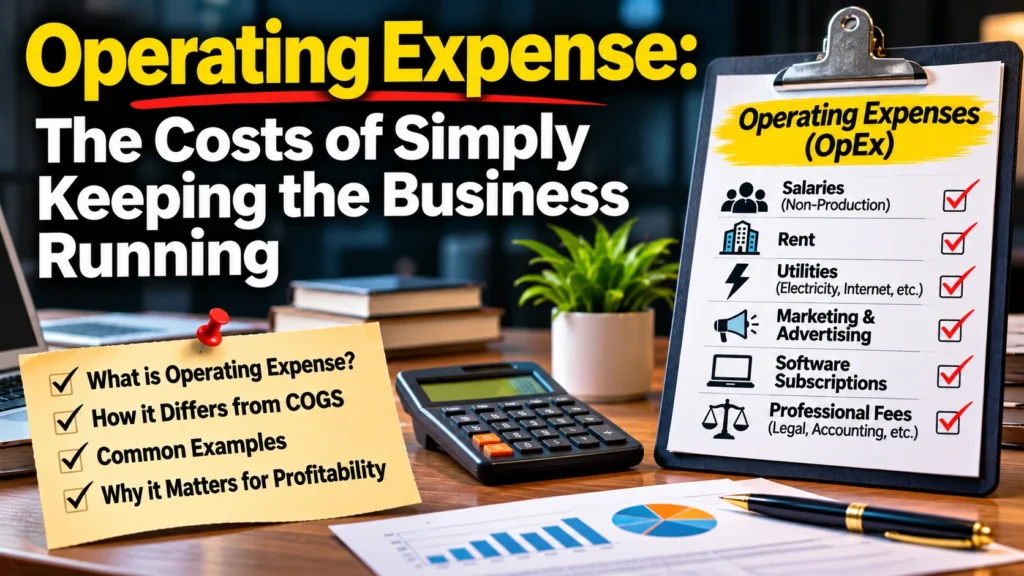
Operating Expense: The Costs of Simply Keeping the Business Running
Rent doesn't stop just because sales slow down for a month. Neither does the marketing team's salary, the office electricity bill, or the software subscriptions running quietly in the background. These are operating expenses — the costs a business incurs simply to function, regardless of how directly they're tied to producing whatever it sells.
What Falls Under Operating Expense
Operating expenses (often shortened to OpEx) cover the costs of running a business's day-to-day operations, distinct from the cost of goods sold, which covers direct production or procurement costs. Common categories include salaries for non-production staff, rent and utilities, marketing and advertising spend, administrative costs, software subscriptions, and professional fees like legal or accounting services. On the income statement, operating expenses are subtracted from gross profit to arrive at operating profit.
This distinction between COGS and OpEx matters because it separates two different kinds of cost discipline. A company might do an excellent job sourcing materials cheaply (strong gross margin) but still bleed money through bloated administrative overhead or excessive marketing spend (weak operating margin) — and the two problems require entirely different fixes.
A Worked Breakdown
A digital marketing agency with ₹3 crore in annual revenue and minimal direct production cost (since the "product" is largely people's time and expertise) reports operating expenses of ₹2.1 crore — ₹1.4 crore in salaries, ₹30 lakh in office rent and utilities, ₹25 lakh in software tools and subscriptions, and ₹15 lakh in marketing and business development spend. After these operating expenses, and assuming gross profit was close to the full ₹3 crore given the low direct cost base, operating profit comes to roughly ₹90 lakh — a 30% operating margin.
Tracking operating expense as a percentage of revenue over time — sometimes called the OpEx ratio — reveals whether a company is scaling efficiently. If revenue grows 40% year over year but operating expenses grow 60%, the business is losing operating leverage, meaning costs are outpacing the sales growth meant to justify them.
Fixed Versus Variable Operating Costs
Not all operating expenses behave the same way as revenue changes. Rent and most salaries tend to be fixed, staying roughly constant regardless of sales volume in the short term. Marketing spend and sales commissions tend to be more variable, scaling up or down with business activity. Understanding this split helps a business model how profit will respond to a revenue increase or downturn — a business with mostly fixed operating costs sees profit swing much more sharply with revenue changes than one with mostly variable costs.
FAQ
Is depreciation an operating expense?
Yes, depreciation on office equipment, computers, and similar assets used in operations (not direct production) is typically classified as an operating expense.
Can operating expenses be reduced without hurting the business?
Sometimes — renegotiating vendor contracts or cutting redundant software subscriptions can trim costs painlessly, but cutting into marketing or key staff too aggressively can hurt future revenue.
How is operating expense different from capital expenditure?
Operating expenses are day-to-day running costs expensed immediately, while capital expenditure covers long-term asset purchases that are capitalized and depreciated over time.
Bottom Line
Operating expense is the price of simply keeping a business functioning day to day, and how efficiently a company manages this cost relative to its revenue growth is often a better signal of management quality than revenue growth alone. This is general information, not financial advice.
Sources
- Institute of Chartered Accountants of India — icai.org
